From the timing desk — filed by v01d_pr13st before the window opens, scored after it closes.
SUBJECTTwo weeks when stalled work starts moving again — and the best use of the movement is to check it, not to lock in final terms on the last day.
Two weeks when stalled work starts moving again — and the best use of the movement is to check it, not to lock in final terms on the last day.
SUMMARYThe short version
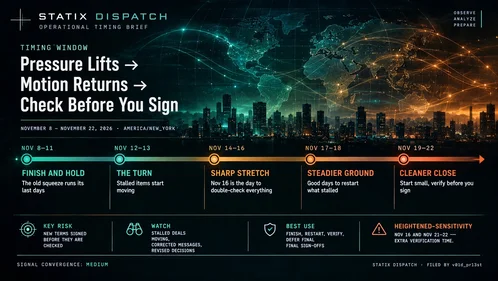
Stalled work starts moving again in the middle of this window. From Nov 8 to about Nov 11, the old squeeze is still on: finish what is open and do not start new commitments. Between Nov 12 and Nov 17, the pressure lets go in stages — stalled items start moving, messages and terms run straight again, and the sharpest day is Nov 16. From Nov 18 to Nov 22 the ground is cleaner, but the newest changes are only days old, so start small and verify before you sign anything final. The window closes Nov 22.
PRIMARY DRIVERSWhat's moving the window
- Stalled work un-stalls mid-window. The blockers that held the second half of October let go one by one Nov 12–17.
- Messages and terms run straight again after Nov 13–14. Corrections are still needed, but the direction is forward.
- Nov 16 is the sharpest day. Three pressures meet, claims run hot, check before you send.
- A title or a confident tone still does not settle an argument. The midterms just proved the loudest claim is not the settled one.
- Disagreements stay defensive, not attacking. Sides protect what they already have.
- The Gulf and Beijing stay live. Post-midterm decisions and the plenum's aftermath keep moving through the window.
EXPECTED EFFECTSPhase by phase
- Nov 8–11 — Finish and hold. The old squeeze runs its last days. Nov 11 is the window's quiet hinge — authority questions surface, answers come later. Do not start new commitments.
- Nov 12–13 — The turn. Stalled items start moving. Expect fast changes and re-check each one as it lands.
- Nov 14–16 — The sharp stretch. Messages and terms run straight again, but Nov 16 is the day to double-check everything before it goes out.
- Nov 17–18 — Steadier ground. Good days to restart what stalled.
- Nov 19–22 — Cleaner close. Start small, verify terms in writing, and do not lock long-term commitments on Nov 22 itself.
FROM THE WIRESRegional lenses
The Gulf decision window is open now.
What the wires say: the Iran war is in its ninth month. Oct 28, CENTCOM posted Hormuz shipping routes cleared of mines; within two days Iran's Revolutionary Guard claimed three tankers had struck mines, CENTCOM denied it, and a projectile strike south of Lavan was confirmed. Oct 31, Iran offered a two-day Hormuz reopening plan tied to US concessions. The Oct 23 intelligence memo warned Iranian plotting against US personnel had reached advanced stages, and the State Department pulled non-emergency staff from Saudi Arabia. US and Israeli planning, as reported Oct 23, pointed at possible renewed strikes in early November, after the Nov 3 midterms — and the White House said plainly there would be no attack before those elections. The elections are over. That decision window is open now.
What the timing adds: the window's sharp day (Nov 16) and its closing days (Nov 21–22) are where statements get walked back and advisories change. Expect first reports that get revised, not settled facts on first hearing.
What to do: anyone with people, travel, or shipments touching the Gulf should check current advisories and routing in writing before moving, not on the assumption of last week's picture. Watch for revisions, not just first reports.
Beijing's purge lands, then the follow-through.
What the wires say: China's ruling Central Committee closed its fifth plenum Oct 29 with the largest purge on record — 33 senior officials expelled, sixteen of them military, including two former top generals. Anti-corruption chief Zhang Shengmin was added to the Politburo, the first mid-term addition in 32 years, and the top military command is down to two men: Xi and Zhang. The 21st Party Congress is set for the second half of 2027. Separately, Washington proposed expanding investment curbs on sensitive technology Oct 23, and Beijing opposed them and reserved countermeasures. Taiwan's security agency reports China-origin false and disputed information targeting Taiwan up nearly half this year, ahead of November local elections.
What the timing adds: the moves surfaced Oct 30–Nov 4 and were already scored in the last dispatch. Through this window, watch the follow-through — new appointments filling the emptied seats, investment countermeasures, and discipline-themed announcements. A personnel or investment move that lands in this window should be read as priced under the new terms.
What to do: if a deal, price, or supply line touches China, verify its terms in writing. Treat plenum-week silence as normal, not as good news.
Home lens: the midterms are counted, the aftermath is not.
What the wires say: Nov 3 handed both chambers to the Democrats — the House past 218, the Senate 54–44 with seven seats flipped, five governorships flipped — the first divided government of Trump's final two years. But the counting is still being corrected: Nov 5, AP fixed a Florida vote total after a data-entry error; Nov 7, a Georgia House district flipped after an overlooked memory card was found. The new Congress does not sit until January, so the lame-duck session and the transition claims run straight through this window.
What the timing adds: the cost-of-commitments squeeze that ran Oct 31–Nov 2 is easing through this window, while messaging friction peaks late — right at the Nov 22 close. In plain terms: expect transition and lame-duck claims to be loud, contested, and revised, with the sharpest day Nov 16 and the most careful reading needed Nov 21–22.
What to do: treat election-night and transition claims as provisional until confirmed. Re-read everything Nov 16 and again Nov 21–22. Do not finalize plans on a claim that has not been checked twice.
WATCH ITEMSWhat to look for
- A stalled deal, project, or approval that starts moving again Nov 12–17
- A message, version, or document corrected after it went out
- A term or price agreed early in the window that gets re-read and changed before it closes
- A defensive public row where one side is protecting what it already has, not attacking
- Decisions announced Nov 21–22 that get revised within days
- A Gulf or Hormuz statement, incident, or advisory change that gets revised within days
- A Beijing personnel or investment move that changes terms after Nov 8
- A midterm-aftermath claim (vote total, transition, or lame-duck item) corrected or revised Nov 14–17
BEST USEHow to play it
- Do: finish open work Nov 8–11; restart stalled items Nov 17–18; verify terms in writing and check the exact version; re-price plans after the mid-window turn; write down who approved what; schedule any final, hard-to-undo sign-offs for after Nov 22; check travel advisories before Gulf or Middle East travel; verify any China-touching deal terms in writing; treat election and transition claims as provisional until confirmed.
- Avoid: new commitments Nov 8–11; treating a senior title or a confident tone as proof; repeating a claim nobody checked; sending a heated message on Nov 16; locking long-term terms on Nov 21–22; moving people or shipments on last week's Gulf picture.
HEIGHTENED SENSITIVITYNovember 16, and November 21–22
November 16, and November 21–22 — the days when double-checking matters most. Nov 16 is the sharp day; Nov 21–22 is the close, when the newest changes are only days old. Nov 12–13 are fast-change days: re-check each move as it lands. (No narrower timing is claimed for this window.)
SIGNAL CONVERGENCEMedium
Statix Dispatch — Operational Timing Desk. This brief describes timing and pressure patterns, not guarantees. Decision-support, to be used alongside real-time information and your own judgment. Filed by the desk — check it against the wires. That's what they're for.